An Olympic sprint can be settled in less than a heartbeat, yet rules beyond raw speed decide whether a performance counts. From the starter’s commands to the wind reading beside the track, small distinctions explain why a runner may be recalled, disqualified, or denied a record after crossing first. These Olympic sprint rules cover the 100m and 200m, focusing on the decisions spectators most often question.
How Olympic sprint starts work
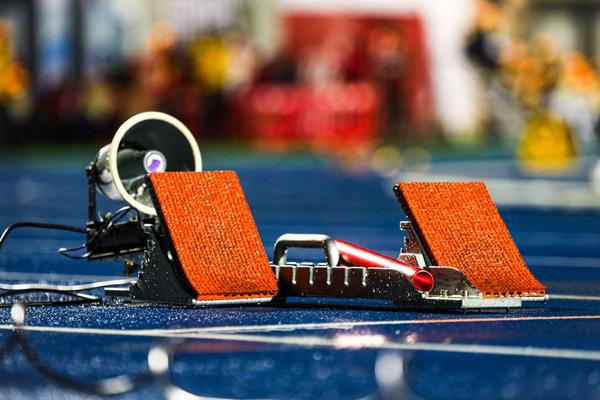
In the 100m and 200m, athletes begin in crouched positions using starting blocks. The starter calls “On your marks,” allowing runners to take their positions with hands behind the start line and feet against the blocks. At “Set,” they rise into their starting positions and must remain steady until the signal.
The gun does not have to fire a fixed number of seconds after “Set.” The starter waits for a fair start. If an athlete reports a legitimate disturbance, officials may interrupt the procedure rather than forcing the race to begin.
What counts as a false start?
The false start rule is strict: an athlete responsible for a false start is normally disqualified immediately. Electronic systems connected to starting blocks help officials assess reactions. A reaction time below 0.100 second triggers a possible false-start indication for officials to evaluate.
That figure is not a target to aim for. A reaction of 0.120 second is legal; a reading of 0.090 second raises concern. Officials also examine movement and circumstances. An athlete who disrupts the starting commands may face disciplinary action even when the incident is not classified as a conventional false start.
In a final, anticipating the gun can be costlier than reacting a fraction later. The 100m Olympic rules reward a fast legal response, not a guessed start.
Why sprinters have assigned lanes
The 100m takes place on a straight, with each athlete in a separate lane. In the 200m, runners begin at staggered positions around a bend before entering the home straight. The stagger compensates for the different distances around the curve, letting everyone cover 200 metres.
Under the 200m lane rules, competitors must remain in their assigned lanes through the finish. Moving inward can shorten the distance and lead to disqualification. Officials review apparent infringements and relevant exceptions; not every incidental touch of a line automatically brings the same penalty.
Lane assignments follow the event’s draw and seeding procedures. In later rounds, higher-ranked qualifiers may receive preferred lanes. An outside runner can appear ahead early in a 200m because of the stagger. The apparent lead disappears as runners approach the straight; what matters is who reaches the common finish first.
Wind readings and record eligibility
Outdoor 100m and 200m times come with a wind reading in metres per second. A positive number indicates a tailwind; a negative number means a headwind. For standard record recognition, the maximum permitted tailwind is +2.0 m/s.
Imagine a 100m winner clocking 9.85 seconds with +1.8 m/s wind. The performance satisfies the wind condition for a record. The same time with +2.3 m/s is wind-assisted: it remains a valid race result but cannot qualify as a standard world record. Excess wind never automatically cancels a medal.
Measurement periods differ. In the 100m, the wind is sampled for 10 seconds beginning with the start signal. In the outdoor 200m, the usual 10-second measurement begins when the first athlete enters the home straight. The gauge sits beside the track rather than following runners around the bend.
When comparing historical performances, check both the clock and the legal wind reading instead of assuming the lower time was achieved under equivalent conditions.
Qualifying heats, semifinals, and the final
Olympic sprint champions generally race more than once. Early rounds narrow the field to semifinalists and finalists. In traditional heats, a specified number of athletes advance by finishing position, sometimes joined by additional qualifiers based on time. Each event publishes its precise advancement rules.
Formats can change between Games. At Paris 2024, the individual 200m used a repechage round, giving certain athletes another opportunity after their first-round heats. The 100m did not use that repechage format because it already included preliminary races. Neither arrangement should be assumed to apply unchanged at every future Olympics.
When reading results, look for official qualification markings and the event schedule. A runner’s route to the final depends on that round’s advancement system, not simply where their time ranks across the entire field. Understanding Olympic athletics qualifying rounds helps explain why two athletes with similar times may face different outcomes.
How a legal sprint finish is decided
The winner is the athlete whose torso first reaches the vertical plane of the nearer edge of the finish line. A foot, hand, arm, leg, head, or neck crossing first does not decide victory. That is why leaning the chest forward can matter in a close finish, while throwing an arm out does not.
Fully automatic timing and photo-finish cameras resolve tight placements. Television angles may appear to show another winner because the official camera is aligned with the finish line.
Picture two athletes arriving together: one extends a foot across the line, but the other’s chest reaches the finish plane first. The second athlete wins. Knowing how track photo-finish decisions work prevents confusion when the result differs from the first television impression.
Other actions that can invalidate a sprint
False starts and lane violations are not the only offences. Obstructing another runner, interfering with an opponent’s progress, or behaving improperly can prompt review and possible disqualification. Officials may also restart a race after an external disruption prevents a fair contest.
For spectators, the practical lesson is to wait for the confirmed result if the start, a lane incident, or possible obstruction is under review. An apparent winner is not always the official winner.
Frequently asked questions
Is one false start allowed in an Olympic 100m race?
No. In ordinary Olympic sprint events, an athlete responsible for a false start is disqualified. Each competitor does not receive one free false start.
Can an Olympic 200m runner switch lanes?
No. Runners must follow their assigned lanes around the bend and down the straight. Officials assess any infringement under the applicable rules.
Does a tailwind above +2.0 m/s make a sprint result invalid?
No. The race result stands, but the time cannot satisfy the normal wind requirement for a world record.
Does the head crossing the finish line first decide the winner?
No. The torso determines the finish, which explains why the official photo finish sometimes differs from ordinary video.
Final perspective
Olympic sprinting is simple at heart: start legally, respect your lane, and bring your torso across the finish before anyone else. Electronic start checks, wind readings, qualification formats, and photo finishes make the contest fair and measurable. Learn those distinctions and even the closest 100m or 200m final becomes easier to understand.