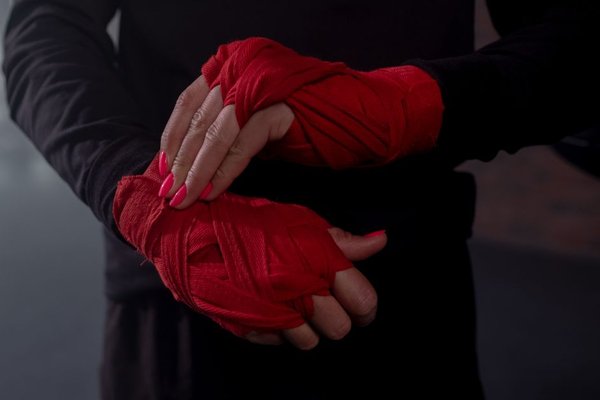
Boxing gloves get most of the attention, but hand wraps sit closest to the joints taking every punch. A good wrap should feel secure without making your hands stiff or numb, and it must fit comfortably inside your gloves. This boxing hand wraps guide explains what wraps do, how types and lengths differ, and the basic wrapping routine to learn before your next bag session.
What Hand Wraps Actually Do
Hand wraps provide a supportive layer around the wrist, hand and knuckles. They help control unwanted movement and add modest cushioning over the knuckles during bag work, pad drills and sparring. They cannot, however, make a poorly landed punch safe or eliminate injury risk.
Think of boxing wrist support as one part of a system. Wraps, suitable gloves, sound punching mechanics and sensible intensity all matter. If your wrist repeatedly bends on impact, more fabric cannot replace coaching on alignment. A boxing stance and punching technique guide can explain why impact position matters just as much as equipment.
The Main Types of Boxing Hand Wraps
Traditional cotton wraps
Reusable cotton strips have little or no stretch. They hold a consistent shape, which some boxers prefer for a firm feel. Careful tension matters, though: folds and overly tight turns can become uncomfortable under a glove.
Mexican-style stretch wraps
Often made with cotton and elastic fibres, these conform easily around the hand. They can be forgiving while learning a wrapping pattern, but stretching them too tightly may restrict circulation. The right fit is snug, never constricting.
Quick wraps and gel inner gloves
Slip-on options save time and sometimes add padding over the knuckles. Wrist coverage varies by design. They may suit certain fitness sessions but are not necessarily equivalent to full-length cloth wraps for harder punching.
Gauze and tape
Often used in regulated bouts, gauze and tape are generally applied by a qualified corner team under event rules. They are not ordinary reusable gym wraps. Competitors should check their governing body’s current requirements.
How to Choose a Boxing Wrap Length
Common retail lengths include 120 inches (about 3 metres) and 180 inches (about 4.6 metres). Shorter wraps may work for younger boxers, small hands or simple patterns. Many adults prefer 180 inches because there is enough material for the wrist, knuckles and passes between the fingers.
Longer is not automatically better. Excess fabric can create bulky layers that stop your glove closing comfortably, while a short wrap may run out before the wrist is secure. Choose a boxing wrap length that gives even coverage without crowding the glove.
For example, if a 180-inch wrap leaves a thick bundle at the wrist, check your layering technique first. If the layers are smooth yet the glove still feels cramped, try a shorter or thinner wrap. A boxing glove size guide can also help you assess the complete fit.
How to Wrap Hands for Boxing
Coaches teach different methods, so this sequence is a starting framework rather than the only correct pattern. Begin with clean, untangled wraps, your fingers relaxed and spread, and the fabric lying flat.
Anchor the thumb loop and wrist
Put the loop around your thumb and bring the fabric across the back of the hand to the wrist. Circle the wrist roughly two or three times using comfortable tension. Avoid a thick ridge over the joint.
Cover the knuckles
Move diagonally across the back of the hand and make several smooth passes over the knuckle area. Keep your fingers spread. Return toward the wrist in a crossing pattern rather than letting fabric twist into a cord.
Connect the fingers and secure the thumb
Many methods pass the fabric through the spaces between fingers to keep the knuckle layers positioned. Your coach can show you the appropriate route. Some methods also include a controlled pass around the base of the thumb before returning to the wrist.
Finish and test the wrap
Use the remaining material for balanced wrist support and fasten the tab where it will not rub. Open and close your hand several times. You should form a comfortable fist without tingling or pain. Learning how to wrap hands for boxing is about repeatable, even tension, not an exact number of turns.
A Better Fit Test: Put Your Gloves On
A wrap can feel fine with an open hand yet become restrictive when you make a fist. Test both positions, then put on your actual gloves. Your fingers should remain warm and normally coloured, without pins and needles. Rewrap more loosely if you notice numbness, discolouration or discomfort.
After a few light punches, check for slipping knuckle layers or fabric creases pressing into your skin. Correct those problems before increasing power. This reveals more about practical boxing hand protection than pulling the wrap as tightly as possible.
Common Mistakes and Easy Fixes
Beginners sometimes pull stretch wraps too hard, wrap with clenched fingers or leave twisted folds under the glove. Start with an open hand, smooth each pass and check fist comfort throughout. If gloves suddenly feel too small, inspect the amount of fabric bunched around the knuckles or wrist.
Persistent discomfort during bag work also deserves a technique check. Review heavy bag training basics with your coach rather than simply adding layers or punching through pain.
Cleaning and Replacing Your Wraps
Let wraps dry after training instead of leaving them damp in your gym bag. Wash according to the care label, ideally in a mesh laundry bag to limit tangles, and dry completely before reuse. An extra pair makes regular training easier.
Replace wraps when the elastic stops recovering, fabric tears or fasteners no longer hold. Persistent pain, swelling, weakness or numbness deserves medical assessment, not tighter wrapping.
Frequently Asked Questions
Do beginners need hand wraps?
For regular bag, pad and sparring sessions, reusable wraps are generally a sensible choice. Ask your coach which type and method suit your training.
Are 120-inch or 180-inch wraps better?
Many adults find 180-inch wraps easier for complete coverage. Shorter 120-inch wraps can suit smaller hands or simpler methods. Fit matters more than a universal rule.
Should boxing wraps feel tight?
They should feel snug and supportive, never painfully tight. Tingling, numbness or trouble making a fist means you should loosen and reapply them.
Can I hit a heavy bag with wraps alone?
No. Wraps provide limited cushioning and are not a substitute for properly selected boxing gloves during bag work.
Build a Reliable Wrapping Routine
Effective hand wrapping is a small skill worth practising. Choose a comfortable material and length, keep layers smooth, and confirm the fit inside your gloves. Then give your punching technique as much attention as your gear.