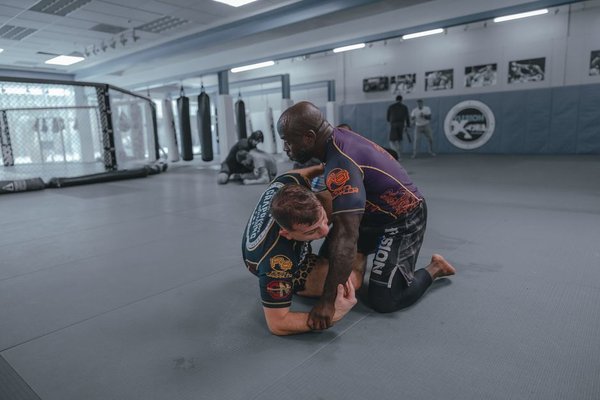
A fighter can look comfortable on the mat one moment and tap the next. That sudden finish is part of what makes submissions so compelling in mixed martial arts. Yet successful holds are rarely random tricks. They follow a chain of positional control, a recognizable threat, and a decision about whether it is safe to continue.
Understanding MMA submission basics means learning what chokes and joint locks threaten, which positions create them, and how to recognize danger early. You do not need to memorize dozens of techniques to read these exchanges more clearly.
What Counts as a Submission in MMA?
A submission occurs when a fighter concedes, usually by tapping the opponent or mat, or by verbally signaling surrender. A referee can also stop a bout to protect a fighter who cannot safely continue. Under the Unified Rules of MMA, a verbal tap may include an audible cry indicating pain or discomfort.
Most submission threats fall into two families: chokes, which involve the neck, and joint locks, which threaten a limb joint. Both can become dangerous quickly. In training, a tap is a safety signal, not a test of toughness.
MMA Chokes: Understanding the Main Families
Chokes that restrict blood flow
Many MMA chokes compress structures around the neck and reduce blood flow to the brain. Unconsciousness can occur rapidly, sometimes without significant pain. That is why a person should never rely on discomfort as the only sign of danger.
The rear-naked choke is a familiar example, usually associated with back control. The arm-triangle and triangle choke are also common, although their positions differ. Each illustrates an important principle: controlling an opponent’s movement and posture can matter more than visible force.
Front-headlock attacks
A guillotine choke often becomes a threat when someone exposes their head during a takedown attempt or scramble. Depending on the hold, pressure can affect circulation, the airway, or both. Beginners should learn to recognize these situations under supervision, not experiment with how long they can tolerate neck pressure.
Competition rules also distinguish legal chokes from fouls. Directly grabbing the trachea is prohibited under the Unified Rules, and particular restrictions depend on the event’s rule set.
MMA Joint Locks: Leverage, Not Brute Strength
MMA joint locks work by controlling a limb and threatening a joint beyond its normal, safe range. Because leverage can create substantial force, even a smaller fighter may threaten a stronger opponent. Injuries can happen suddenly if a hold is applied explosively or resisted carelessly.
Elbow and shoulder attacks
The armbar is an elbow-lock family that commonly appears when an opponent’s arm becomes isolated. The kimura and Americana are well-known shoulder-lock variations. These names help viewers identify attacks, but their shared safety lesson is simpler: never twist a trapped limb aggressively in an attempt to escape.
Lower-body submissions
Leg-lock families include straight ankle locks, kneebars, and rotational attacks. Some place especially rapid stress on the knee or ankle. Not every technique is legal in every organization, amateur division, or grappling class. Learn recognition and appropriate defenses only with a qualified coach who understands the relevant rules.
The Positions Behind Submission Attempts
A submission usually becomes possible because one fighter controls where the other can move. Back control creates rear-facing choke threats. Mount can let the top fighter isolate an arm. Side control may lead to shoulder attacks or an arm-triangle. Guard can produce chokes and armbars from the bottom, while scrambles create front-headlock opportunities.
These patterns are useful, not automatic. Defenders who maintain posture and protect vulnerable limbs may prevent a threat from developing. For more positional context, the guides to Brazilian jiu-jitsu positions and wrestling takedown basics are natural next reads.
Why MMA Submission Grappling Is Different
Submission grappling competitions focus primarily on holds and positional exchanges. MMA adds punches, elbows where permitted, the cage, and the possibility of standing back up. A position that creates an attacking opportunity in a grappling match may expose someone to strikes in an MMA fight.
An attacker who concentrates entirely on a choke can also lose track of defense or position. Timing therefore matters as much as technique. Our guide to MMA ground-and-pound fundamentals provides a useful companion to this part of the sport.
Key Principles of MMA Submission Defense
Good MMA submission defense begins before a hold is fully secured. Recognizing a bad position gives a fighter more options than reacting after the neck is trapped or a joint is nearly extended.
Keep a stable posture during transitions rather than reaching blindly. Avoid leaving an arm isolated far from the body. Pay attention when an opponent gains firm positional control, and practice suitable escapes under supervision. Do not treat breath-holding, pain tolerance, or frantic twisting as reliable defensive strategies.
Above all, tap early and clearly. Tap your partner or the mat repeatedly, or say “tap” if your hands are occupied. The partner applying the hold must release immediately. If you feel faint, notice unusual neck symptoms, or experience joint pain, stop training and seek appropriate medical assessment.
A practical example: spotting an armbar threat
Imagine a slow, supervised drill. Your partner moves from mount and separates one of your arms from your body. You notice that your elbow is increasingly controlled and that your ability to withdraw the arm is disappearing. That is the time to communicate and tap, not to yank the arm free against resistance.
After resetting, ask the instructor where you lost your defensive position. This creates a useful learning cycle: recognize the warning earlier, improve positioning, and prevent the dangerous stage next time. Partners should apply holds gradually and never punish someone for tapping.
Frequently Asked Questions
What is the difference between a choke and a joint lock?
A choke threatens the neck and may interfere with circulation or breathing. A joint lock threatens a limb joint through leverage. Both require prompt release when a person taps.
Are all submissions legal in MMA?
No. Rules differ across organizations, ages, and amateur or professional competitions. Check the exact event rules rather than assuming that every move seen online is allowed.
What should beginners learn first for submission defense?
Begin with safe tapping, recognizing positional threats, protecting the neck and limbs, and supervised basic escapes. These habits matter more initially than complicated counters.
Can a submission happen while standing?
Yes. Choke threats can arise during standing clinches and takedown exchanges, although many submissions finish on the ground. Control and positioning remain central in either case.
Putting the Basics Together
Watch submission exchanges as a sequence: control first, a threat to the neck or joint second, and a defensive response third. Once those connections become familiar, MMA chokes and joint locks become easier to understand. For anyone training, calm positional awareness, qualified instruction, and an early tap are more valuable than trying to endure a dangerous hold.