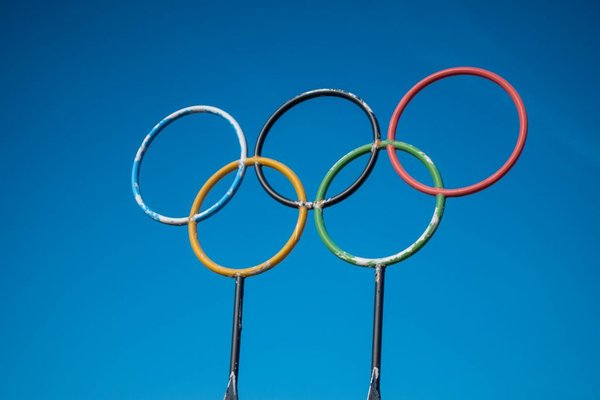
Few symbols can be recognized as quickly as the five interlocking Olympic rings. They appear across the Games worldwide. Their meaning, however, is often simplified into a story that is only partly correct. The Olympic rings represent the worldwide reach of the Olympic Movement and the meeting of athletes from across the globe. Their five colours were chosen for international symbolism, but the familiar claim that each colour belongs to a particular continent is not the official explanation.
What Do the Olympic Rings Mean?
The meaning of the Olympic rings is rooted in unity. Pierre de Coubertin, founder of the modern Olympic Movement, designed the five interlaced rings in 1913. He described them as representing the five parts of the world brought together by Olympism. The interlocking design reinforces that idea: separate regions are visually connected within one symbol.
Today, the Olympic symbol represents the universality of Olympism and the gathering of athletes from around the world at the Olympic Games. It also evokes friendship, excellence, respect and peaceful competition.
The five regions traditionally associated with the rings are Africa, the Americas, Asia, Europe and Oceania. This is a geographic idea rather than a colour code. No official Olympic ring colour is assigned to any one continent.
Why Are There Five Olympic Rings?
The number five reflects the international scope that Coubertin wanted the modern Games to express. After the 1912 Olympic Games in Stockholm, participation had become increasingly global, and Coubertin wanted an emblem that could communicate that wider reach.
The rings were not created simply as a decorative logo. Their interlaced form makes the international character of the Olympic Movement immediately visible. Its durability comes partly from communicating connection without words.
What Do the Olympic Ring Colors Represent?
The official Olympic ring colors are blue, yellow, black, green and red, traditionally shown against a white background. Coubertin explained that the six colours together, including the white background, could reproduce colours found in the national flags of countries participating in the Olympic Movement at the time.
This point is frequently misunderstood. You may have seen charts claiming that blue represents Europe, yellow Asia, black Africa, green Oceania and red the Americas, or some variation of that list. That colour-to-continent mapping is not the official meaning of the Olympic rings.
A useful way to remember the distinction is simple: the five rings collectively represent the global union embodied by Olympism, while the colours were selected to create an international emblem with broad representation among national flags. The symbolism belongs to the whole design, not to five separate colour labels.
A Short Olympic Logo History
1913: Coubertin Creates the Rings
Pierre de Coubertin designed the five-ring emblem in 1913. In writing about the design, he emphasized both the five parts of the world and the international character created by the combined colours.
1914: The Symbol Enters Olympic Use
The rings were presented in connection with the Olympic Congress in Paris in 1914. An early Olympic flag carrying the design also appeared that year. The First World War then interrupted the Olympic schedule, so the symbol did not immediately appear at a Games.
1920: The Olympic Flag Is Raised at the Games
The five rings made their first Olympic Games appearance on the flag at Antwerp 1920. From there, the emblem became central to Olympic identity. Careful standards have preserved its consistent appearance.
Why the Interlocking Design Matters
The rings are not five isolated circles placed beside one another. Their interlacing is essential to the symbolism. It turns individual shapes into a connected system, visually matching the idea of athletes and nations meeting through sport.
A viewer does not need to know a language, read a slogan or recognize a host city to understand that the mark represents the Olympics. The form works across cultures and generations.
For broader context, readers may also explore Olympic ceremonies and traditions, the history of the modern Olympic Games, and Olympic medals and symbols as natural related topics.
Can Anyone Use the Olympic Rings?
The rings are highly protected. Under the Olympic Charter, the International Olympic Committee controls rights connected with the Olympic symbol and other Olympic properties. Commercial use is not something a business should assume is permitted simply because the image is famous or easy to reproduce.
Protection also extends internationally through intellectual-property laws and, in countries that are parties to it, the Nairobi Treaty on the Protection of the Olympic Symbol. The treaty requires participating states to protect the five interlaced rings against unauthorized commercial use, subject to its terms.
For a practical example, imagine a local company planning to print the rings on T-shirts and sell them during the Games. Recreating the symbol from scratch would not make the use automatically legal. The business would need to check Olympic brand rules, local law and any required authorization before producing or advertising the merchandise. Editorial or educational discussion is a different context, but it is still wise to avoid implying official sponsorship or endorsement.
Why the Symbol Still Works
The strongest feature of the Olympic rings is their simplicity. They carry history without looking historical, and they express international connection without relying on a map or written explanation. Host cities can change their own emblems, mascots and visual themes, yet the rings remain the constant element linking each Games to the wider Olympic Movement.
The symbol also shows how easily popular interpretations can become mistaken “facts.” Understanding the true Olympic rings meaning makes the design more interesting: the colours are not a coded map of continents, but part of a deliberately international emblem created to represent a worldwide sporting movement.
Frequently Asked Questions
What do the five Olympic rings symbolize?
The five interlaced rings symbolize the worldwide reach of Olympism and the meeting of athletes from across the globe. They are commonly associated with five world regions: Africa, the Americas, Asia, Europe and Oceania.
Does each Olympic ring color represent a continent?
No. The IOC does not assign blue, yellow, black, green and red to individual continents. Coubertin selected the colours, together with the white background, because they collectively reflected colours found in national flags.
Who designed the Olympic rings?
Pierre de Coubertin designed the rings in 1913. The symbol was introduced in the following period and appeared at the Olympic Games for the first time in Antwerp in 1920.
Are the Olympic rings protected?
Yes. The IOC controls the Olympic symbol under the Olympic Charter, and additional protection comes from national laws and international arrangements including the Nairobi Treaty in participating states. Commercial use generally requires careful rights clearance and, where applicable, authorization.
A Symbol of Global Connection
The Olympic rings have lasted because their message is both specific and universal. Five interlaced circles express the international scope of the Olympic Movement, while the colours help create an emblem intended to speak across national boundaries. Knowing the history also clears up the most persistent misconception: the colours do not officially correspond to individual continents. Seen in that light, the rings are less a coded diagram and more a compact visual statement about athletes, nations and regions meeting through sport.