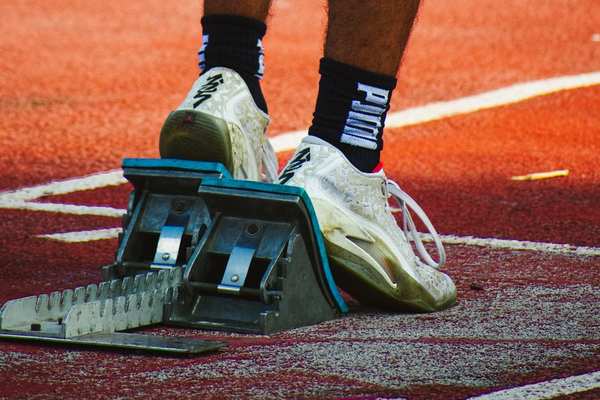
The 200 meters is short enough to demand near-maximal speed, yet long enough to punish a reckless first half. That makes it different from simply running two 100-meter sprints back to back. A strong 200 meter sprint strategy blends an explosive start, efficient curve running, controlled speed development, and the ability to preserve mechanics when fatigue rises on the straight.
The goal is not to “save energy” in the ordinary sense. The 200 is still an all-out sprint. The skill is distributing effort so you reach high speed without creating unnecessary tension or spending so much on the bend that your stride falls apart over the final 60 to 80 meters.
Start Fast Without Forcing the First 50 Meters
From the blocks, accelerate aggressively. Push powerfully through the first steps, keep an appropriate forward body angle, and let the torso rise gradually instead of popping upright. What changes in the 200 is what happens after that initial drive.
Rather than straining for more speed with every step, allow acceleration to become smoother as you approach top speed. Recent research on elite 200-meter racing suggests that a slightly more controlled first half can support better second-half speed, although the ideal distribution depends on the athlete. Controlled does not mean slow; it means fast without excessive muscular tension.
A useful cue is: attack the start, then settle into speed. If your shoulders are tight and your face is strained before halfway around the bend, you are probably spending too much effort too early.
Use the Curve Instead of Fighting It
Curve running technique matters because the bend changes how force is applied compared with straight sprinting. Research has found that sprint velocity can be lower on a bend and that the inside and outside legs do not behave identically. Trying to run the curve exactly like a straightaway can therefore make the movement feel forced.
Lean From the Whole Body
Allow a subtle inward lean from the whole body rather than bending sideways at the waist. Keep the head aligned with the torso, hips tall, and foot contacts close to underneath you. The lean should respond naturally to speed and lane radius rather than becoming an exaggerated tilt.
Keep the Arms Compact and Rhythmic
Strong arm action helps maintain rhythm, but over-rotating the shoulders wastes motion. Drive the arms forward and back with relaxed hands and keep the upper body calm enough for the legs to cycle quickly. Smoothness is especially useful on tighter bends.
In training, repetitions of roughly 80 to 120 meters that begin on the curve can help athletes practice this skill at speed. Work on sprint start technique separately as well, because an efficient opening phase makes the transition into bend running much easier.
Transition Off the Bend Smoothly
A common mistake is treating the end of the curve like a new race. Sprinters sometimes try to “kick” as soon as they see the straight, creating tension and disrupting rhythm. Instead, carry speed smoothly from the bend onto the straight.
As you leave the curve, become more upright and let the inward lean disappear naturally. Keep applying force without reaching for longer steps. Your stride may feel more open on the straight, but that should come from speed and posture rather than deliberate overstriding.
A practical cue is to run through the bend exit, not merely to it. Mentally target the first 10 to 20 meters of the straight. That helps prevent an early relaxation point and reduces the temptation to make a sudden technical change at the transition.
Make Sprint Pacing About Relaxation, Not Jogging
Good 200m race tactics are sometimes misunderstood as backing off in the middle. Competitive sprint pacing is subtler. You are still moving at very high speed; the aim is to remove unnecessary tension while preserving velocity. Think fast hips, loose jaw, relaxed hands, and a rhythm you can carry into the straight.
This is where speed endurance becomes decisive. Athletes who maintain posture, step rhythm, and force application under fatigue lose less velocity late in the race. Well-recovered sprints over distances such as 120, 150, 180, or 200 meters can develop this quality when programmed appropriately. A focused speed endurance workouts guide is a useful companion to race-strategy work.
Finish by Protecting Your Mechanics
The final straight usually does not reward a dramatic increase in effort. By then, most sprinters are already close to their maximum sustainable output. Trying harder can make them slower if it creates stiffness, shortens the stride, or causes reaching.
Focus on posture and rhythm. Keep the hips high, eyes forward, elbows moving, and feet contacting quickly under the body. Let the arms help carry the rhythm when the legs feel heavy. The sensation may be that you are accelerating, even when the real objective is simply to lose less speed than the runners around you.
A complete track sprint training plan should combine acceleration, maximum-velocity work, bend practice, and speed endurance rather than relying only on repeated hard 200s.
A Simple Race Model to Practice
Think of the race as four connected phases. Drive powerfully from the blocks, build speed around the bend without tightening up, flow off the curve while preserving momentum, then protect posture and rhythm through the finish line.
In practice, give each phase one cue rather than several. For example: “push,” “smooth,” “carry,” and “tall.” Simple cues are easier to execute at race speed. Use timed splits when possible, but judge technique as well as the stopwatch. A faster opening split is not automatically better if it produces a large late-race slowdown.
FAQ
Should you run the first 100 meters of a 200 all-out?
You should accelerate hard and reach very high speed, but all-out should not mean tense or uncontrolled. Many athletes benefit from an aggressive yet technically controlled first half that leaves them better able to preserve speed on the straight.
How should you lean when running the curve?
Use a natural inward lean through the whole body rather than bending at the waist. The amount of lean changes with speed and lane radius, so avoid forcing an exaggerated position.
Where do runners usually start to fade in the 200?
Fatigue often becomes most visible in the final 60 to 80 meters. That is where posture, relaxation, and speed endurance become especially important. The aim is not to avoid fatigue but to maintain efficient mechanics as it increases.
What is the best way to practice 200-meter race strategy?
Combine curve sprints, acceleration work, high-quality speed endurance repetitions, and partial or full race rehearsals with generous recovery. Practice the same simple cues you intend to use in competition so the strategy becomes automatic under pressure.
Finish Strong by Running Smart
A strong 200 is built on controlled aggression. Accelerate decisively, respect the technical demands of the bend, carry speed smoothly onto the straight, and respond to fatigue by protecting rhythm instead of forcing longer or harder steps. When curve mechanics, sprint pacing, and speed endurance are trained together, the final meters become less about surviving and more about maintaining enough speed and coordination to compete through the line.