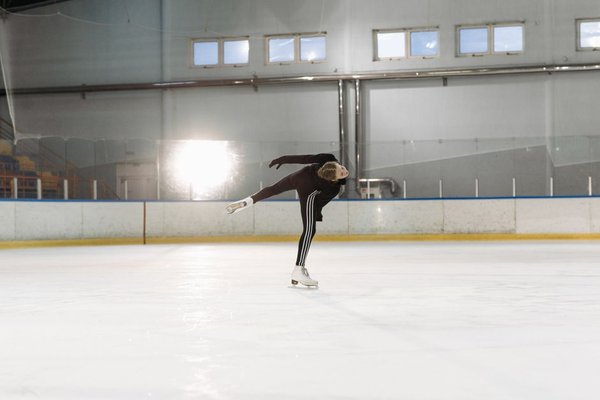
A figure skating spin can look like one continuous blur, yet small changes in the skater’s body position reveal very different skills. A straight standing shape, a low crouch and a horizontal extension all belong to different spin families. Once you recognise those shapes, even a complicated competition combination becomes easier to follow.
This guide explains figure skating spin types, why some spins travel across the ice, and how competitive levels work. It also shows what developing skaters can practise before trying the eye-catching variations seen in elite programs.
The Three Basic Figure Skating Spin Positions
Competitive singles skating recognises three basic positions: upright, sit and camel. A skater can perform each on either foot, and variations change the silhouette without necessarily changing its underlying family. Position definitions matter because a spin must meet technical requirements, not merely resemble the shape from a distance.
Upright Spin
In an upright spin, the skating leg is straight or slightly bent and the position does not qualify as a camel. The familiar scratch spin is an upright variation: the free leg draws inward, often alongside the skating leg, while the arms close toward the body.
Other upright variations include layback spins, where the torso arches backward or sideways, and the Biellmann, where the skater pulls the free skate overhead. These dramatic shapes demand flexibility, but a controlled basic upright spin comes first.
Sit Spin
A sit spin lowers the skater into a squat-like position. Under the technical definition, the upper part of the skating leg must be at least parallel to the ice. Simply bending both knees slightly does not produce a qualifying sit position.
Common variations include a cannonball, in which the skater folds toward the extended free leg, and a pancake position, with the upper body lowered over that leg. A strong sit spin combines depth with a steady centre; dropping low is less useful if the blade immediately skids outward.
Camel Spin
In a camel spin, the free leg extends backward with its knee higher than hip level. The torso generally leans forward, creating a long, nearly horizontal line. A weak or drooping free-leg position can prevent the shape from meeting the technical definition.
Camel variations may include a bent-leg catch-foot position or a donut shape, where the free skate approaches the head. The essential challenge is maintaining an extended line while balancing over a tiny contact area of the blade.
Single-Position, Combination and Flying Spins
The basic positions describe body shapes; spin elements describe how those shapes are organised. That distinction helps explain why competition commentators use several names for seemingly similar movements.
Spins in One Position
A one-position spin stays within one basic family, although the skater may vary the arms, free leg or body shape. A change-foot version transfers the rotation from one skating foot to the other. The final upright winding-down motion of another spin does not automatically create an additional basic position.
Combination Spins
A combination spin moves between basic positions, perhaps beginning in camel, dropping into sit and rising to upright. Transitions must be controlled, not merely rushed through. In international singles competition, the number of qualifying positions affects the element’s base value, so clear positions matter as much as visual variety.
Flying Spins
A flying spin begins with a visible jump into rotation. A flying camel and flying sit are familiar examples. The jump is an entrance, not a fourth basic spin position. Skaters need confident takeoff and landing mechanics before adding difficult flying entries.
What Makes a Spin Fast and Well Centred?
Spins rely on control of the skating edge, body alignment and angular momentum. When a skater draws the arms and free leg closer to the rotation axis, the spin often speeds up. Opening the shape usually slows it down. This is why a scratch spin may accelerate visibly as the limbs pull inward.
Centering means rotating around a relatively stable spot rather than spiralling across the rink. A beautifully shaped camel can still travel if the entry is unbalanced or the skater’s weight shifts away from the turning axis.
How Figure Skating Spin Levels Work
In the International Skating Union judging system, technical specialists identify the spin and its difficulty level. Judges separately assess how well it was performed using Grade of Execution, or GOE. A Level 4 spin with poor balance can therefore earn a lower execution grade than a cleaner spin with fewer difficulty features.
For the 2026/27 singles rules, Level 1 generally requires one credited feature, Level 2 two, Level 3 three and Level 4 four. Examples include difficult variations, a qualifying change of edge, a clear increase in speed, difficult entrances or exits, and certain changes of rotational direction. Not every feature may be repeated for credit, and the rules place limits on how many variations count within one spin.
There is an extra hurdle for Level 4: at least one specifically designated feature must count, such as a qualifying difficult exit, edge change, speed increase, difficult flying-entry variation or windmills. Simply collecting four ordinary-looking changes does not guarantee Level 4. Requirements can change between seasons, so competition-specific rules should be checked when analysing scores.
A Practical Progression for Learning Spins
Imagine a learner who can hold a brief two-foot spin but drifts sideways whenever they try one foot. Instead of chasing a faster scratch spin, their next session should focus on entering calmly, finding balance over the skating foot and finishing in control.
Start with a coach-supervised two-foot spin, then practise a basic one-foot upright spin from a consistent entry. Count controlled revolutions rather than chasing speed. Once the centre becomes repeatable, experiment with drawing the arms inward gradually. Sit and camel positions can follow when edge control, strength and posture are ready.
For more skating-skills practice, explore basic figure skating edges, three-turns for beginners and figure skating balance drills. Each develops awareness of weight placement, although spin entries still require specialised instruction.
Frequently Asked Questions
What are the main types of spins in figure skating?
The three basic position families are upright, sit and camel. Skaters also perform combination spins, change-foot spins and flying spins, which describe how positions or entrances are combined.
Why do figure skaters spin faster when they pull their arms in?
Drawing the limbs closer to the body reduces rotational inertia. With angular momentum approximately conserved, that usually increases rotational speed.
Is a Level 4 spin always better than a Level 3 spin?
No. Level describes credited difficulty features, while GOE reflects execution. A cleaner Level 3 spin can look better and receive stronger execution marks than a poorly controlled Level 4 attempt.
Which spin should a beginner learn first?
Many learners begin with a two-foot spin and progress to a simple upright one-foot spin under a qualified coach’s guidance. Sit and camel spins are normally introduced after balance and basic edge control improve.
Putting the Pieces Together
To understand a spin, identify its basic position first, then notice changes of foot, variations, entrances and exits. Look for steady centering and controlled speed before thinking about levels. With that simple viewing framework, spins stop looking like a blur and start revealing the technique behind each rotation.