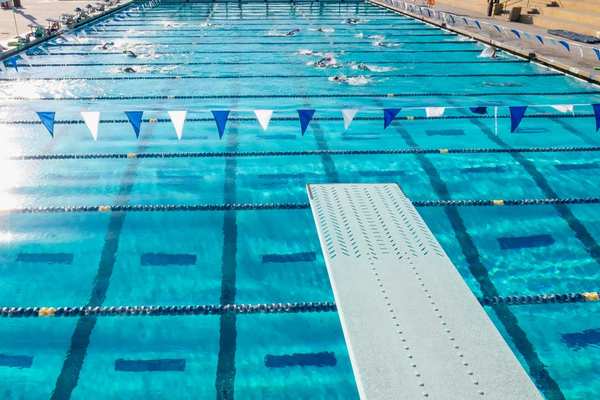
From the pool deck, springboard and platform diving can look like two versions of the same sport: a takeoff, twists or somersaults, and a carefully controlled entry. The real difference begins before the diver leaves the board. A springboard flexes and returns energy; a platform stays still. That changes how athletes generate height, plan rotations and manage their position above the water.
For anyone comparing springboard vs platform diving, the useful question is not simply which is higher. It is how each discipline turns a different takeoff into a precise dive, and why competitions treat them as distinct events.
Springboard vs Platform Diving at a Glance
Both disciplines reward controlled technique, accurate body positions and a near-vertical entry with minimal splash. Their equipment creates different challenges.
Springboard diving uses a flexible board, usually one or three metres above the water. The diver bends it through a timed approach or standing movement, then uses the rebound to rise. Platform diving uses a solid surface, commonly at five, 7.5 or ten metres. Major senior international platform events use the ten-metre level.
Springboard specialists coordinate with moving equipment; platform specialists launch from a stable surface and manage a longer drop. Neither event is automatically easier.
Equipment and Height: Where the Difference Begins
How a springboard produces lift
A competition springboard flexes under the diver’s weight. Its adjustable fulcrum changes the board’s response, although the setting cannot replace sound technique. Divers practise steps, the hurdle and final press so the rebound lifts them upwards rather than pushing them away from the end.
The three-metre springboard is an Olympic event. One-metre springboard also appears in other competitions, including world-level championships. A lower board does not necessarily mean a simple dive: gaining enough height for rotations requires timing.
How a fixed platform changes the takeoff
A platform does not return energy. The diver pushes from a rigid edge using leg power, alignment and, for certain dives, an armstand start. With no bounce to coordinate, departure may seem simpler, but small positioning errors become significant from ten metres.
Five- and 7.5-metre platforms play important roles in training and age-group programmes. They are not the ten-metre platform used for Olympic medals.
Takeoff Technique and Control in the Air
Springboard diving often features a rhythmic forward approach: steps, a hurdle, board contact and upward rebound. The athlete must extend at the right instant before rotating. A poorly timed press costs height and complicates the dive. Backward and reverse takeoffs bring different balance demands.
On platform, divers use standing or running takeoffs depending on the dive. The greater distance to the water allows demanding combinations, provided the athlete leaves the edge at a controlled angle. Armstand dives add a distinctive challenge: balancing upside down before pushing off.
Both disciplines use straight, pike, tuck and free positions according to the dive. Athletes must open out of rotation, locate the water and form a tight entry line. Extra height does not guarantee an easier landing; it changes flight timing and the consequences of mistakes.
Which Dives Appear in Each Event?
Springboard programmes draw from forward, back, reverse, inward and twisting dive groups. Platform programmes include those groups plus armstand dives, which are not part of springboard competition. Dive codes identify movements and body positions; degree of difficulty reflects technical complexity.
Comparing routines by the number of flips alone is misleading. A clean dive with moderate difficulty may outscore an ambitious but poorly executed one. A guide to diving positions and dive codes helps spectators distinguish a pike from a tuck and understand why similar-looking dives carry different difficulty ratings.
How the Diving Events Work in Competition
At the Olympics, the programme includes individual men’s and women’s three-metre springboard and ten-metre platform, plus synchronised versions of each: eight medal events. Olympic individual events have preliminary, semifinal and final stages, while synchronised events are contested as finals. Other meets can use different formats.
In standard senior individual international competition, women perform five dives and men six. Required dive groups ensure variety rather than repeated favourite skills. Men’s platform programmes cover six groups, including armstand; men’s springboard programmes cover five.
Synchronised diving introduces another test. Two athletes perform the same dive together. Judges consider each person’s execution and how closely their timing, movement and water entry match. An otherwise skilled pair can lose points by falling out of sync.
Are Springboard and Platform Judged Differently?
The underlying standards are similar. Judges evaluate approach and takeoff, flight, body positions, control and entry, awarding execution marks from zero to ten. Scoring discards specified high and low marks and applies the dive’s degree of difficulty to the counted marks. Synchronised events also assess coordination.
Judges do not simply reward the smallest splash. A neat entry can still lose marks for an unstable departure, weak height, loose form or poor alignment. Diving scoring explained is a useful follow-up topic because difficulty and execution jointly determine the total.
Training Demands and Choosing a Discipline
Springboard practice emphasises board rhythm, adjustable-fulcrum awareness, repeatable takeoffs and consistent rebound. Platform practice focuses on powerful controlled departures, orientation during longer falls and confidence at increasing heights. Both require strength, flexibility, dryland drills and qualified coaching.
Consider an athlete who performs a good tuck somersault from one metre but struggles to time the three-metre board. Moving to ten metres would not fix that problem; their coach would first refine board mechanics. An athlete comfortable on a rigid surface may enjoy platform, but still needs gradual, supervised progression through lower heights.
Trying both disciplines with a qualified coach is more informative than choosing from television footage. Facilities, readiness and safe progression matter more than height. A beginner diving safety guide should distinguish supervised competitive training from recreational jumping.
Frequently Asked Questions
Is platform diving harder than springboard diving?
Not universally. Platform adds greater height, a rigid departure and armstand options. Springboard demands precise timing with a moving surface. Difficulty depends on the dive and the athlete.
Why is one-metre springboard not an Olympic event?
The Olympic programme uses three-metre springboard and ten-metre platform. One-metre springboard remains a recognised competitive event at other meets, not merely a practice board.
Can the same diver compete in both disciplines?
Yes. Some athletes compete in both, although many specialise because their takeoff mechanics and training demands differ substantially.
Do platform divers always jump from ten metres?
No. Lower platforms are used in training and some age-group competitions. Ten metres is the standard height for major senior international platform events.
Final Thoughts
The clearest springboard vs platform distinction is how a dive begins: one athlete works with a flexible board, while the other launches from a fixed height. That first movement shapes technique, dive selection and training. Watch the takeoff rather than only the splash, and the unique demands of each discipline become much easier to appreciate.