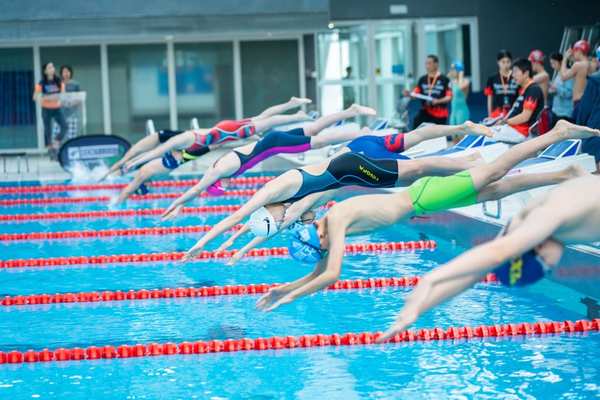
A fast first length can feel like proof that a swim race is going perfectly. It can also be the moment the race begins to unravel. Good pacing is not simply starting slowly and sprinting at the end. It means spending your speed where it produces the best overall time, then recognizing the difference between a planned surge and a desperate attempt to recover lost ground.
Your swim race pacing strategy should change with the event, your strengths, and the pool length. A 50-meter freestyle rewards immediate speed; a 1500-meter race rewards sustainable rhythm. The question is not “How hard can I start?” but “What opening gives me the fastest finish?”
Build a race plan around splits, not feelings
Race splits show how your total time was distributed. A positive split means the first half is faster than the second; a negative split means the reverse. Even pacing keeps successive sections relatively consistent. None is automatically correct for every swimmer or distance. Starts, turns, underwater phases, and fatigue affect the clock.
Choose a realistic goal from recent timed swims, then give each section a job: establish speed, settle at swimming pace, protect the middle, or accelerate home. Use cues you can actually remember while racing. A plan with twelve instructions is rarely useful after the first turn.
50-meter sprint: commit without wasting movement
In a 50, there is little time to correct a timid opening. The start, breakout, and transition into full-speed swimming are part of the race, not a warm-up. Accelerate immediately while keeping the stroke organized enough to carry speed into the finish.
For sprint swimming, “controlled” does not mean easing off. It means avoiding frantic movements that make you slower. In a long-course pool, there is no turn in a 50-meter event; in short-course racing, the turn becomes a tactical opportunity. Know which version you are racing.
100 meters: fast opening, deliberate second half
Most swimmers cannot reproduce their opening 50 speed after fatigue arrives. The dive assists the first length, and a slight positive split is common in sprint events. The mistake is trying to win the race in the first 25 meters and leaving nothing for the return.
Pick one cue for each half. “Explode, then stay long” might help someone who rushes their stroke. “Fast feet off the turn” may suit a swimmer who loses speed at halfway. Rather than chasing the next lane, aim to carry purposeful speed into the final wall.
200 meters: divide the race into four jobs
The 200 is where swim pacing becomes especially tactical. Treating it as an extended 100 often produces a painful third 50; treating it as a relaxed distance swim can leave too much speed unused.
A practical 200-meter race-split example
Suppose your goal is 2:10.00 in the 200 freestyle. One illustrative plan is 30.5 seconds, 33.0, 33.5, and 33.0 for successive 50s. Those race splits add to 2:10.00. They are not universal targets: your start advantage, turns, and previous results should shape your distribution.
The first 50 establishes assertive speed without panic. The second locks into rhythm. The third tests discipline: resist shortening the stroke when discomfort rises. On the final 50, lift effort and defend your pace. Finishing strongly does not require the last 50 to beat the dive-assisted first 50.
400 meters: protect the middle before attacking
In the 400, an ambitious opening 100 can create a deficit no finishing sprint repairs. Aim for a brisk but manageable start, consistent middle sections, and a decisive finish. Research on elite freestyle swimmers shows multiple pacing patterns, so perfectly even splits are not a universal rule.
Give the third 100 special attention. Concentration can slip once the freshness of the start has gone and the finish still feels distant. An effective cue is “hold the next 50,” not “survive another 200.” Small decisions keep a manageable race from becoming a scramble.
800 and 1500 meters: consistency is a competitive skill
In distance swimming, minor overreaching early can compound across many lengths. Establish sustainable pace promptly, then monitor whether each 100 feels controlled enough to repeat. Some swimmers favor an even middle with a faster closing section; others sustain a slight early advantage. Personal race history matters more than copying a champion’s pattern.
Break the event into sections instead of counting every remaining meter. In an 800, use the opening 200 to settle, the middle 400 to protect rhythm, and the final 200 to increase urgency. Short-course races have more turns, so do not apply long-course split targets unchanged.
Use split data without becoming trapped by it
During competition, you may not see a readable clock at every turn. Build a plan around feel and simple cues, then ask your coach or check official results afterward. Compare each 50 or 100 with your intended pattern, not just your total time. Was the opening too aggressive? Did the third quarter fade? Did the finishing effort improve actual speed?
Do not confuse increased perceived effort with a negative split. The second half must be faster on the clock. Rehearse recognizing target pace in training so your judgment is useful when the race becomes uncomfortable.
Adjust when the race stops following the script
Missed a target split? One slower length does not justify an uncontrolled surge. Return to your planned rhythm at the next wall and make a deliberate move when distance allows. If you started too fast, prioritize maintaining forward speed over matching every rival’s acceleration.
For supporting reading, consider freestyle turn timing, swimming stroke efficiency, and race-day preparation. Those subjects influence execution, but your pacing instructions should remain simple enough to follow while tired.
Frequently asked questions
Should I always aim for negative splits?
No. Negative splitting can work in longer races, but the dive often makes the first section faster. Choose a pattern supported by your event and past performances.
How do I pace a race without seeing the clock?
Use rehearsed effort cues, stroke rhythm, and checkpoints such as the halfway turn. Confirm accuracy by reviewing official splits afterward.
What is the biggest pacing mistake in the 200 freestyle?
Starting at unsustainable 100-meter speed is a common problem. The third 50 often reveals whether the opening was realistic.
Can I use the same splits in 25-meter and 50-meter pools?
Not directly. More turns and underwater opportunities can change performance, so set separate expectations for short-course and long-course races.
Finish with a plan you can race
The best swim race pacing strategy is specific enough to guide effort and simple enough to survive pressure. Write down your target splits, assign one cue to each meaningful section, and review what actually happened. Over several races, that comparison turns swimming pace from a guess into a competitive skill.